And Then There Were Toys Part 2
This multi-part article explores the very first American steam toys, their inventors, and the 1870 birth of the American steam-toy industry.
Introduction
In Part 1 we explored the origins of the American steam-toy industry and the first of the successful manufacturers, E.P. Ryder. In Part 2 we'll meet: Alexander and Edward Buckman, John W. Huffington, William Kraft, Samuel D. Greene, George Parr, C.W. Fitch, and Benjamin F. England. What all of these men have in common is a Brooklyn company that began in 1870 as Kraft & Huffington, and Buckman Manufacturing and ended as The Union Toy Mfg. Co. around 1893.
There is understandably a great deal of confusion around the history of these companies. Union Mfg. was a common name chosen both from sense of patriotism, and as a logical name when multiple companies combined. There were two Connecticut Union Mfg. companies; one made tools, another tin toys. There was also a company known as Union Toy and Furniture in Appleton, WI. Further adding to the confusion was the fact that the Union Mfg. Company in Brooklyn that made steam toys, was later known as the Union Toy Mfg. Co.
Ruth and Larry Freeman's 1942 book Cavalcade of Toys notes that A boy with a steam engine needed something to operate with it, and so the miniature machine shop became popular. The Union Manufacturing Company of 13 Vine St., Brooklyn, N.Y., catered to this specialty. The author further writes The Union Company appears to have taken over in 1880 the "Young America" engine.
In the 1947 book The Handbook of Old American Toys by Louis Hertz we get a slightly different version of history; "the Brooklyn N.Y. firm that was successively known as the Buckman Mfg Co. and Kraft & Huffington". The author further notes that the firm started in the 1870s and faded from the scene in the 1890s.
According to the 13th edition of Obrien's Collecting Toys, Kraft & Huffington were producing steam toys in the 1860s. In 1870 the Buckman brothers took over their business, which was then taken over by the Union Mfg Co prior to 1875.
A Brief Summary:
Based on the evidence presented here, the Buckman brothers moved to Brooklyn in 1869 and began working with John Huffington. Huffington and Alexander Buckman were co-inventors on the first two Buckman engines. William Kraft and John Huffington were also business partners, and likely invested in what would quickly become the Buckman Mfg. Co. After the market crash of 1873, also known as the Panic of 1873, and only two years after introducing their first engine, the Buckman brothers drop out of the picture, as does Huffington. The company continued with William Kraft as the Union Mfg. Co. until 1879 when a fire destroyed almost everything. After the fire, Benjamin F. England becomes the proprietor. The Union Toy Mfg. Co., as it was then known, would survive another ten years until the Panic of 1893.
All of this will soon be sorted out in more detail, but first we need to get the Buckman brothers to Brooklyn.
1868: The Buckmans Move To Brooklyn
After the death of his father, Alexander Buckman, 32, the new head of the family in spite of being nearly ten years younger than his brother Edward, moves the entire family, including his 67-year-old mother and 11-year-old daughter, to Brooklyn from East Greenbush, NY, very near Albany. It's reasonable to assume that the Buckmans may have already known people in New York City as they were only about five hours away by rail. The Buckmans arrive in Brooklyn about the same time as Scientific American publishes its steam toy call to action.
Though declaring themselves as painters in every census from 1860 to 1890, the Buckman brothers also appear to be mechanically inclined and quite familiar with the patent system, casting some doubt on the information they so consistently reported to the census takers. These are most of the patents they applied for before coming to Brooklyn: Farm Gates, Horse-Hay Rakes, Improved knife, fork, and spoon cleaning machine, Toy Guns and Mouse Traps.
John Worthington Huffington
Born in 1837, John W. Huffington was two years younger than Alexander Buckman. John had long been associated with lumber starting as a clerk in 1858.
John had three patents to his name, all with Alexander Buckman as co-inventor. Besides the two steam patents listed below, a patent was issued in late 1872 for an envelope with a coin pocket that the postmaster would open to pay for a stamp.
Based on the timing of the patents, Alexander had met Huffington by 1869. He may have also met William Kraft, who was then advertising himself as being a real estate broker. In the 1870-71 Brooklyn city directory Kraft and Huffington would both drop their occupation from their respective listings leaving only their home addresses. This likely signals the beginning of Kraft & Huffington
Other than his initial involvement in the design of the stylish Young America and Little Giant steam engines, and in the formation of Kraft and Huffington, John is not a large part of our story. Shortly after the 1873 market crash he briefly returned to the lumber business, and by 1878 had moved to Connecticut. There he was in the business of etchings and some type of art-related store.
John W. Huffington died in Darien, CT on Jan 16, 1916 at 78 years of age.
The Buckman-Huffington Patents
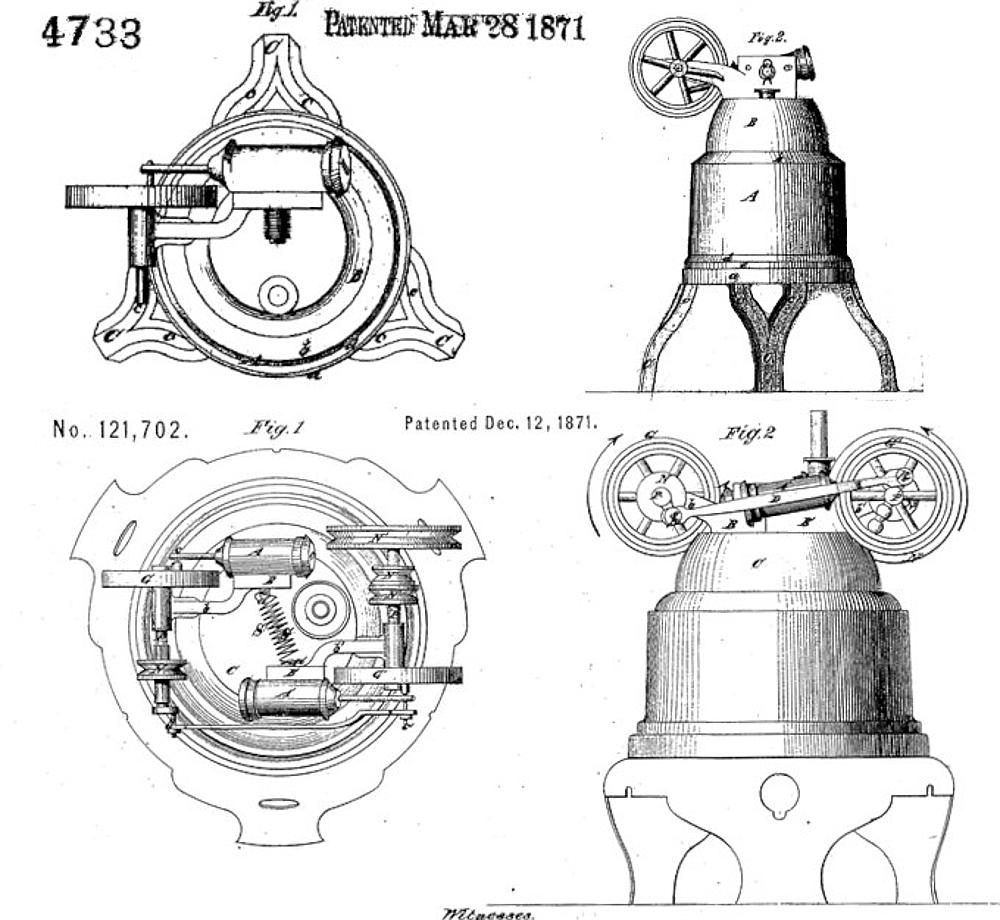
In 1871 patents would be issued for the single-cylinder Young America engine and the two-cylinder Little Giant.
The Young America patent is a design patent for which Alexander Buckman and John W. Huffington get equal billing. Up to this point the Buckman patents were always utility patents and would be more accurately described as practical. This was Huffington's first patent, and what he appears to have brought to the table was style. In spite of being a lumber dealer, Huffington was also an artist. While Alexander Buckman was a painter, at least as reported to census takers, it's not known whether he painted houses, landscapes, or housewares.
The second patent, which was for the two-cylinder Little Giant engine, is a utility patent. Here, Alexander Buckman was the inventor, but the rights to the patent were split between himself and Huffington. This confirms that Alexander was largely, if not entirely responsible for the mechanical aspects of the two engines. It also suggests that Huffington was financially involved.
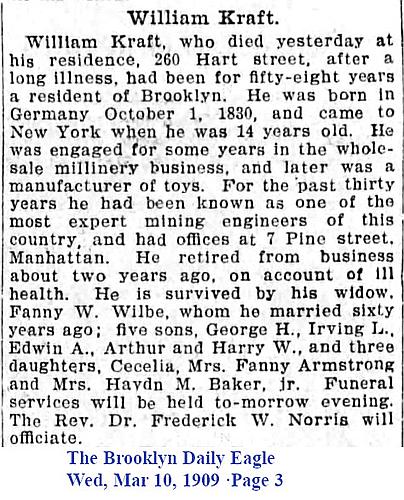
William Kraft
Born in Germany, William Kraft was 40 years old when our story begins. By all accounts he had done reasonably well as he lived in a $50,000 home and listed $5000 in assets in the 1870 census. Besides women's hats (millinery business), he was also a real-estate agent. In 1871 he and Huffington partnered as patent attorneys.
All of the evidence suggests that Kraft was the principal investor in the Union Manufacturing company, and likely the proprietor, though that can't be confirmed. He was involved with the company until about one year after the 1879 fire.
There's no information for 1881 and 1882, but in 1883, while still living at the same address, Kraft doesn't list an occupation. In 1886 he lists his profession as broker, and one year later as mining.
1871: Kraft & Huffington
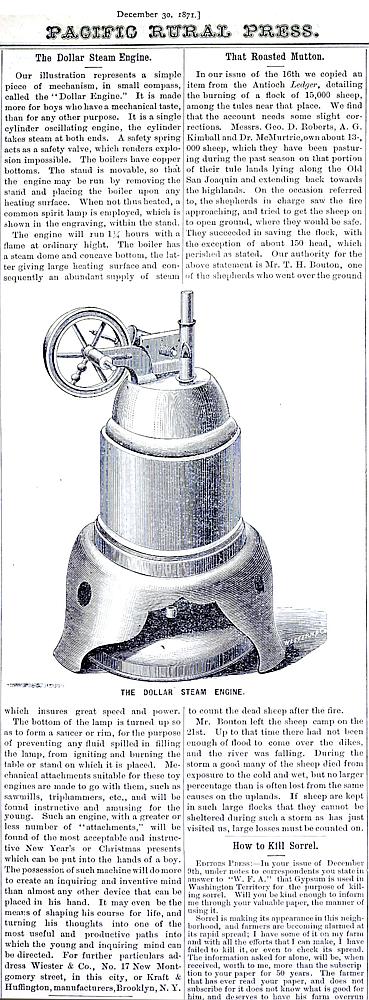
In this Dec 1871 Pacific Rural Press article we learn that the manufacturer of Buckman and Huffington's new engine was Kraft & Huffington of Brooklyn. This bears some scrutiny. Huffington was a lumber dealer/artist. Kraft was involved in the wholesale millinery business (ladies hats), which might imply some experience in manufacturing. It's possible that the Buckman Manufacturing Company was formed in 1871 to manufacture the Young America and Little Giant steam engines for Kraft & Huffington, and that Kraft & Huffington were supplying the capital.
The only reference to "Kraft & Huffington" in directories was in the 1871-72 Brooklyn City Directory where they were oddly listed as patent agents. In this same directory, John W. Huffington described himself as an agent with the same business address, so there's little doubt that this is William Kraft and John W. Huffington.
From the article it also appears that Kraft & Huffington (or the local distributor) were attempting to take market share away from Ryder by branding the engine as the Dollar Engine. Ryder's Dollar Engine came to market about one year earlier, and had reportedly sold 100,000 engines by the time this article was published.
The article's etching represents the earliest form of the famous Buckman-Huffington Young America engine. Note the bead counterweights on the flywheel spoke, and the round holes in the stand legs. The etching also shows a Ryder-style sleeve whistle. All of these features are present in the Little Giant patent. Note that the boiler top (steam dome) does not appear to be removable.
Also published in Dec 1871, just in time for the holiday season, was this catalog from Charles Emerson & Sons of Haverhill, Mass. Here the engine was called the Young America Steam Engine and it initially sold for one dollar. The catalog also explains the two-part design: The stands are movable, so that the engines may be run by removing the stand, and placing the boiler on any heating surface.
The engine price would soon increase to $1.50 and the Young America branding adopted by all retailers.
The Buckman Patents
In 1872 Alexander Buckman and his brother Edward were awarded patents for a fire engine and a steamboat; Alexander also received a patent for his Improved Young America engine. These were all utility patents that were likely applied for towards the end of 1870. The brothers were also awarded an 1873 patent for a self-closing faucet, which suggests that Buckman Mfg. intended to produce more than steam engines.
It's worth noting that none of the new steam-toy patents were assigned to Kraft, or Huffington. It's possible that Buckman intended to manufacture and sell these steam toys through Kraft & Huffington, and may well have, but before the patents were even issued Buckman would start promoting his Improved engine, using his name, as early as May 1871, and as Buckman Manufacturing by Oct 1871.
Huffington likely knew of these patents. The 1872 Buckman-Huffington envelope patent mentioned earlier may have been filed at the same time as these three Buckman patents as all four patents have the same two witnesses, who were likely agents of the American Artisan Patent Agency.
The Improved Young America
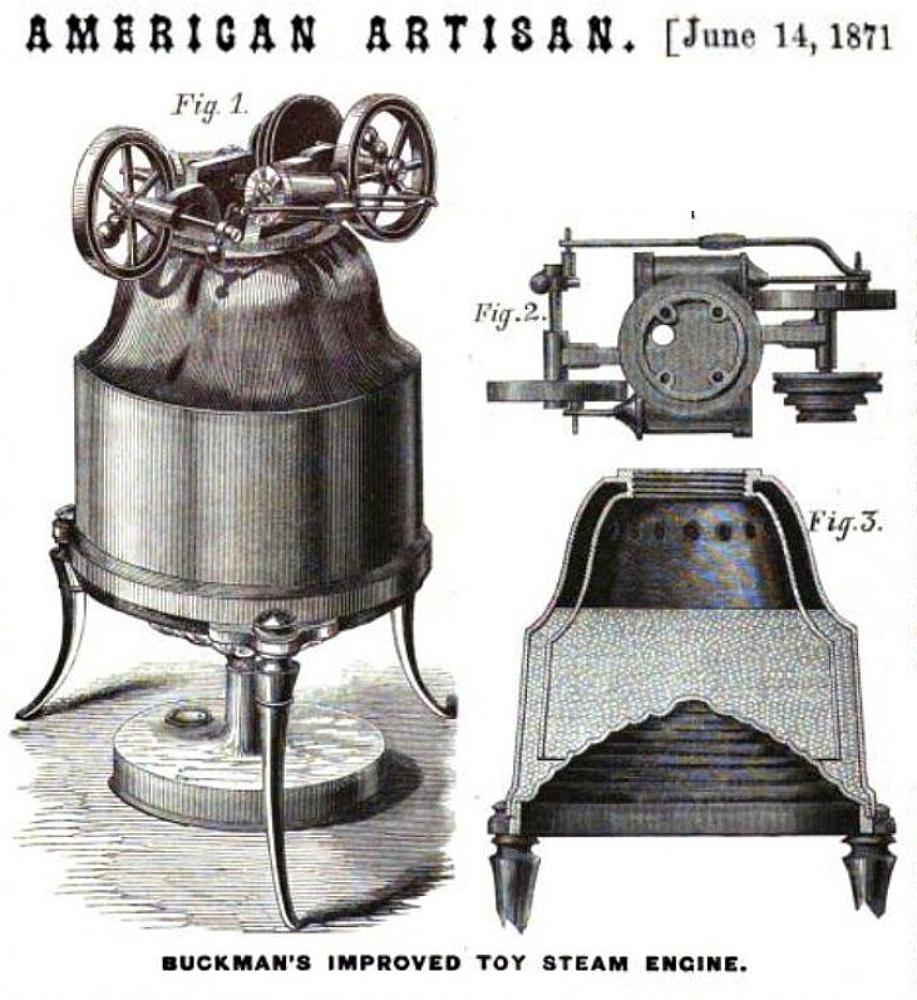
In May 1871, six months after Ryder's engine was featured in Scientific American, American Artisan published the first of two articles on Buckman's Little Giant engine which is depicted in this amazing etching, or cut as they were generally referred to at the time.
The second article, published in June, provides technical descriptions of Buckman's improvements. The double-shell design of the boiler is visible in the etching of the Little Giant, as is the increased surface area on the bottom of the boiler. These changes were made to improve the engine performance when located in a draught of cold air—two-cylinder engines do require more steam. Another change was the addition of a removable top. This made filling much easier and allowed the steam passages to be easily cleared. While the double wall would not be used in the Young America engines, the removable top would be, and the engines sold as the Improved Young America. These improved engines would have been more expensive to manufacture, and that was to be reflected in a price increase to $1.50 for the Improved Young America engine.
The contact information provided for both articles was Alexander Buckman with his home address of 354 Bedford Ave, Brooklyn. What's interesting is that in the 1870-71 city directory, Buckman lists his occupation as a painter with a business address of 70 Spencer, an address that could not be found to be associated with any business.
The Buckman Manufacturing Company
From an Oct 18, 1871 article on the exhibits at the American Institute Fair, the American Artisan reports that "Colby Bros exhibit a stand of mainly mechanical toys and some of the old-style dollar steam engines. [These would have been the Ryder engines described in Part 1]. The Buckman Manufacturing Co. of Brooklyn also exhibit some of Buckman's patent toy engines which have illustrated and described in this paper, and been so reconstructed and modified in form they are about perfect, and much resemble portable engines.". Ryder once had a good relationship with American Artisan. He probably didn't appreciate either the "old-style dollar engine" reference to his engine, or the "about perfect" reference to his new competitor.
The most important thing this article tells us is that Buckman Mfg. Co. was likely established some time before October of 1871, which is the reason for believing that Buckman was building engines for Kraft & Huffington to sell during the 1871 holiday season.
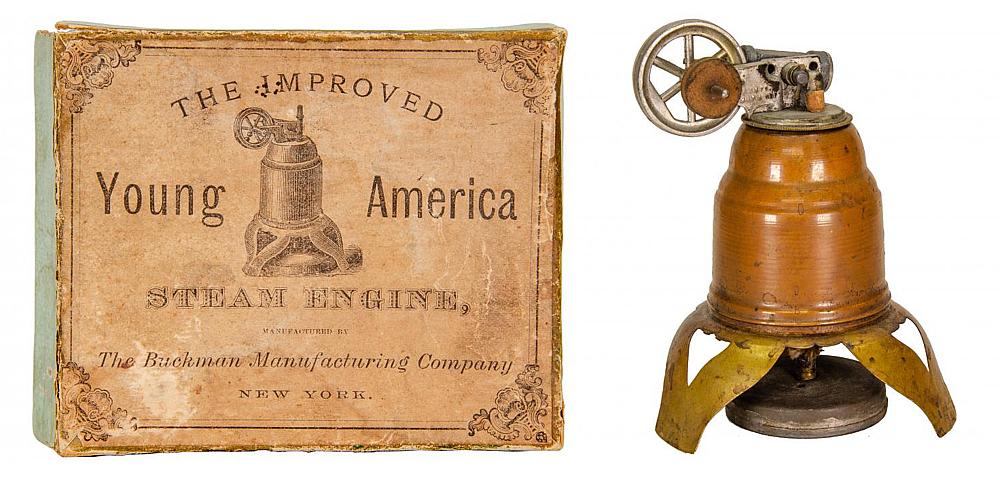
Something changed that caused Kraft & Huffington to stop marketing engines under their name. The Buckman Manufacturing Company would start advertising steam engines in April 1872. Though not explicitly stated, these would be the improved engines, such as the Young America shown above. While Kraft and Huffington did not have any patent rights related to the improvements, the improvements were referenced to the original patents. Whatever the reason for the change, Kraft would remain associated with these steam toys for another decade.
As a company, Buckman Mfg. only had about two years to live before the Panic of 1873 would bring significant changes.
1872: Steam Engines, Fire Engines and Boats
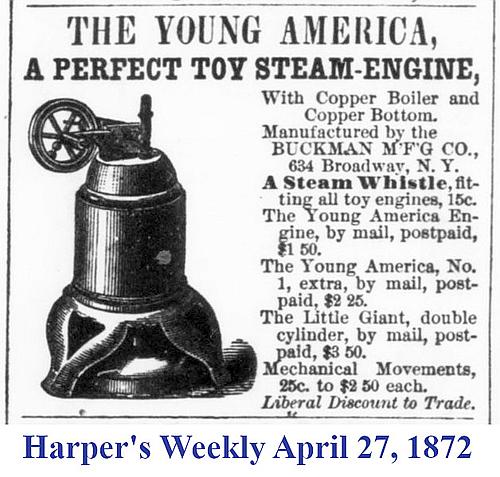
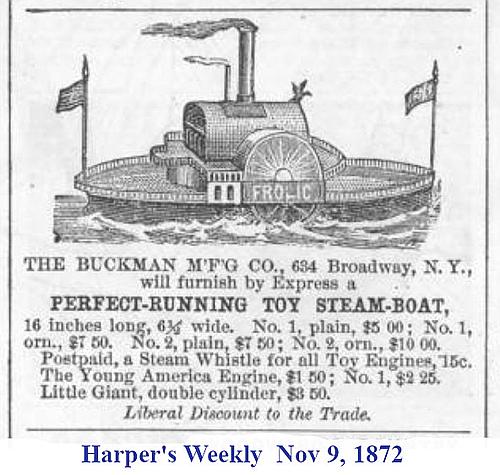
Buckman would begin advertising in April 1872 and would advertise continuously until at least February 1873. Initially these ads were for the Young America $1.50, the slightly larger Young America No. 1 $2.25 and the double cylinder Little Giant $3.50.
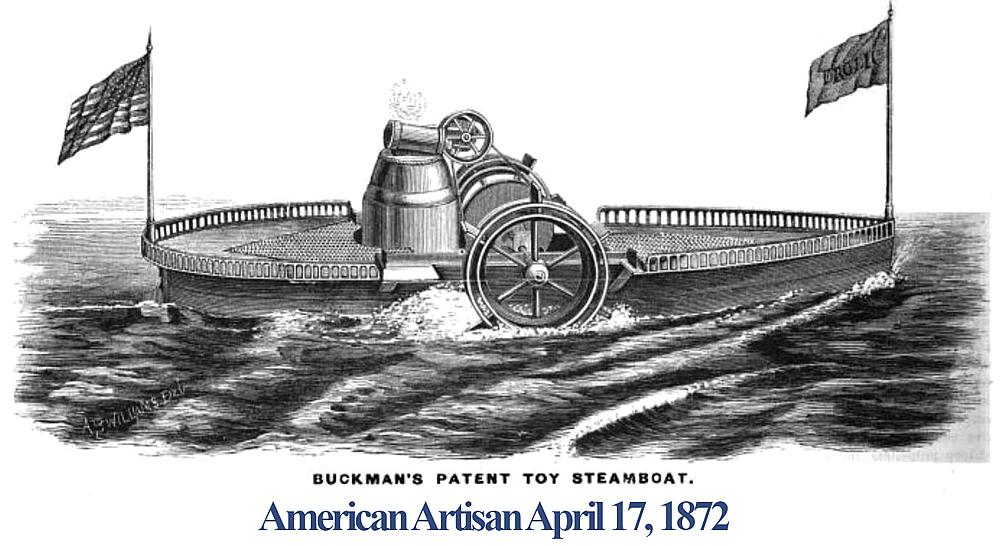
Beginning in August 1872, Buckman would also start advertising his steamboat. There were two variations, No. 1 and No. 2, and two levels for each variation: plain, and ornamented. Prices ranged from $5 to $10.
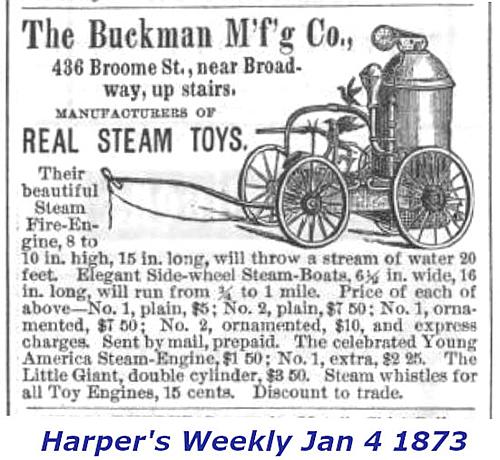
The Fire engine advertising likely started just in time for Christmas. The earliest ad yet discovered was in the the Dec 28, 1872 issue of Frank Leslie's Illustrated Newspaper. That ad is nearly identical to this Harper's Weekly ad that ran in January 1873.
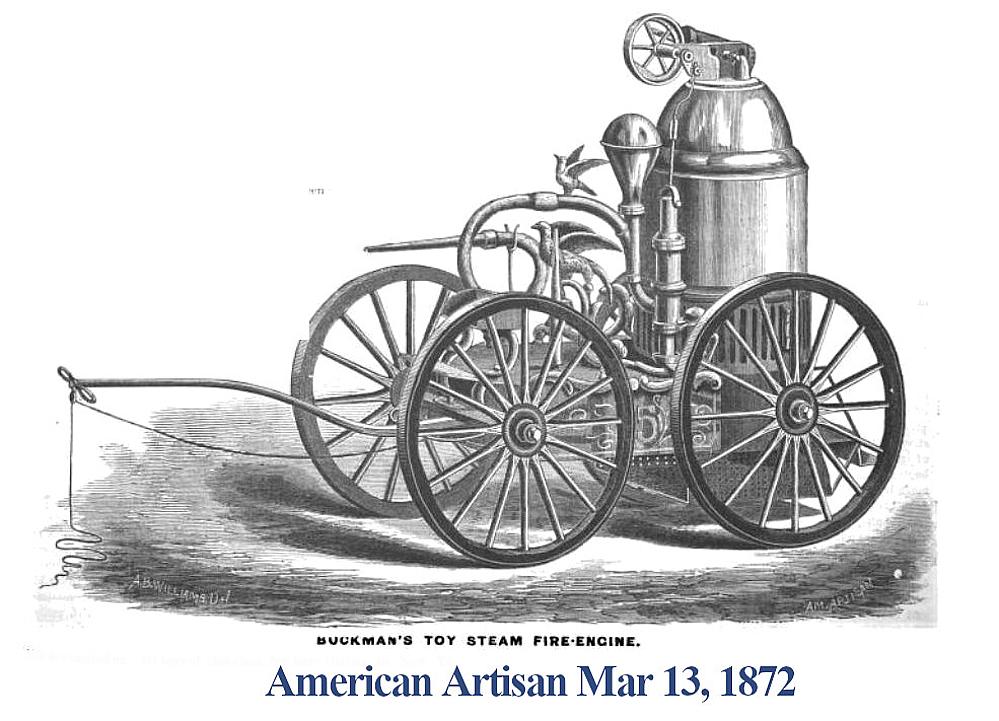
As with the improved steam engines, Buckman would have American Artisan articles for both the Steamboat and the Steam Fire engine.
Buckman's fire engines would prove to be quite popular and would continue to be sold with many variations by Union (Toy) Mfg. Co. While a boat would require a pond, or lake. A boy could start a small fire anywhere and then (hopefully) save the day with his Buckman fire engine.
Two examples of engines that are a close match to the 1872 artwork can be found here and here .
1873: New Products!
A New Engine
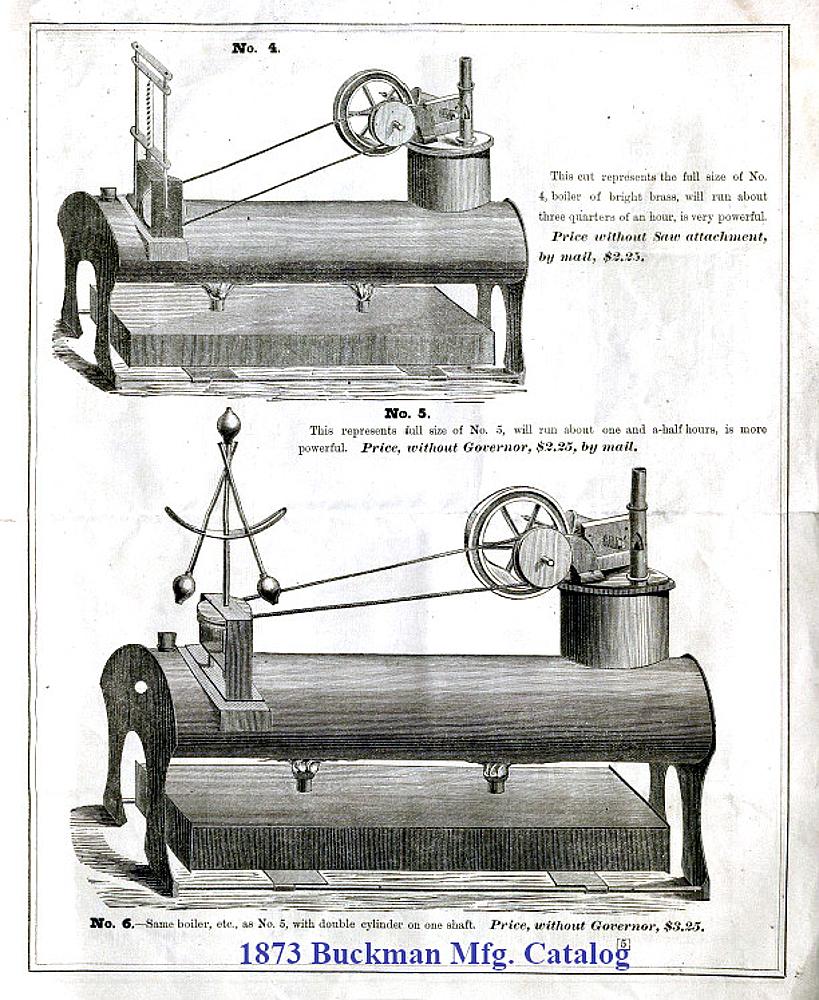
The first new product is a engine with a horizontal boiler . These drawings do not reflect the boiler in its final form, but they do tell us that the design idea for a horizontal boiler predates Union Manufacturing. A horizontal boiler has a naturally larger heating area than engines like the Young America or Little Giant. There can be little doubt that a two-wick burner as depicted here would allow more accessories to be driven.
Here the engines were shown powering boiler mounted accessories such as a governor and an upright saw. A circular saw was also available. We'll see the governor depicted this way in George Parr's miniature machine shop, and as a separate accessory in versions using the Gem engine.
A New Boat
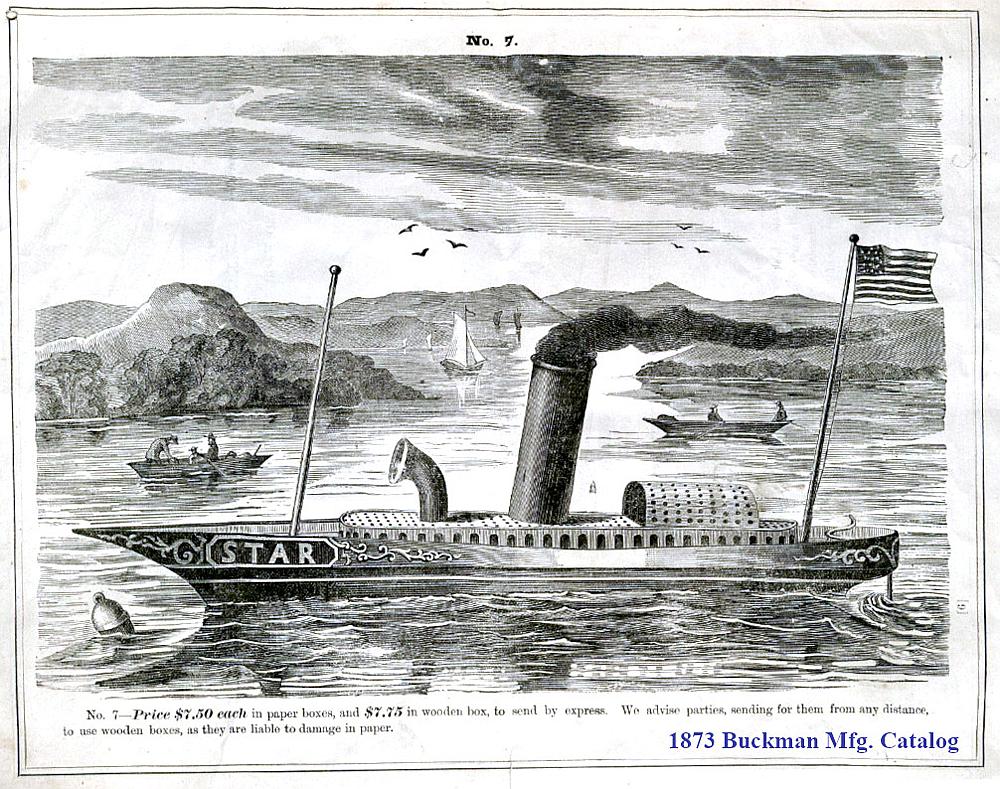
The horizontal boiler configuration is better for small boats allowing a lower deck and an overall lower center of gravity. This may have been one of the motivating factors for the new engine. The catalog doesn't specify which engine was in the new Revenue Propeller boat shown below, but the raised aft-deck profile suggests the horizontal boiler would be used with the cylinders mounted on the boiler as shown above. In the Union Mfg. boats, the steam box and cylinder would be mounted at the propeller shaft. This new boat is 18 inch long.
It's not known if this propeller boat reached production. As will be discussed later, by 1875 Union Manufacturing would introduce three boats including a 19-inch boat, also known as the Revenue Propeller. The Union boats had completely different hulls.
A New Fire Engine (Pumper)
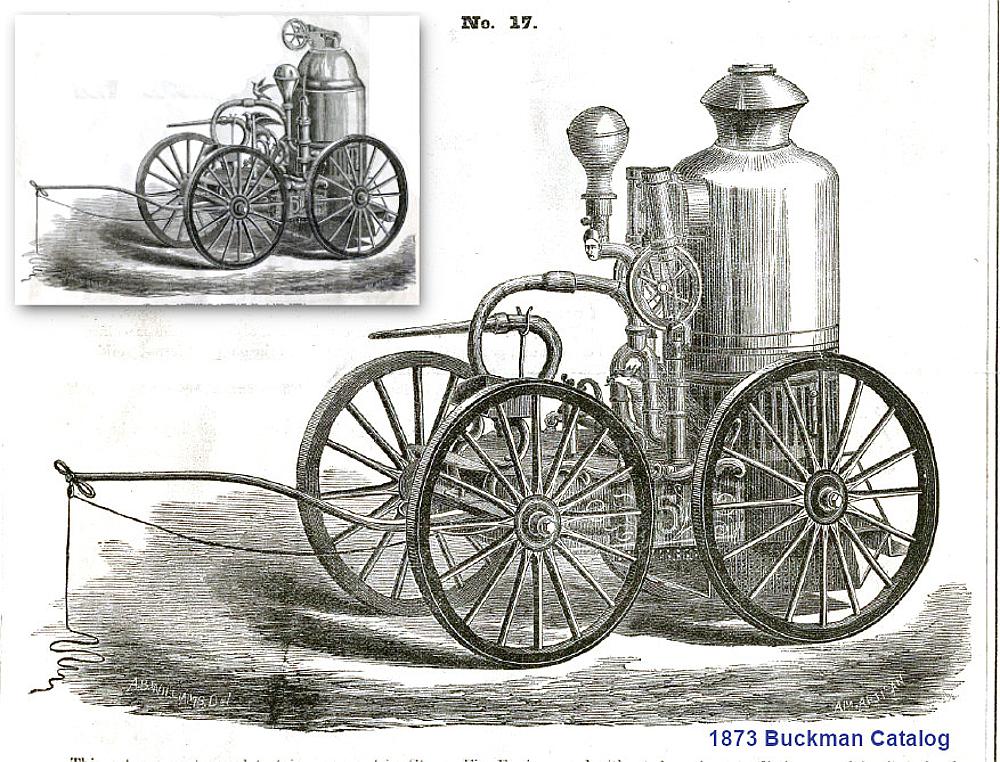
This #17 pumper appears to be new but not yet ready for sale as there's no price listed in the catalog. This etching gives us the first glimpse of what would eventually become the standalone Gem steam engine. Note that the cylinders and steam box are mounted on the side of the boiler.
Prices for the eight listed models ranged from $5 to $12.50. These models were based on the Young America or Little Giant steam engines, with one or two cylinders, a single or double pump, with plain colors and striping, or highly ornamented.
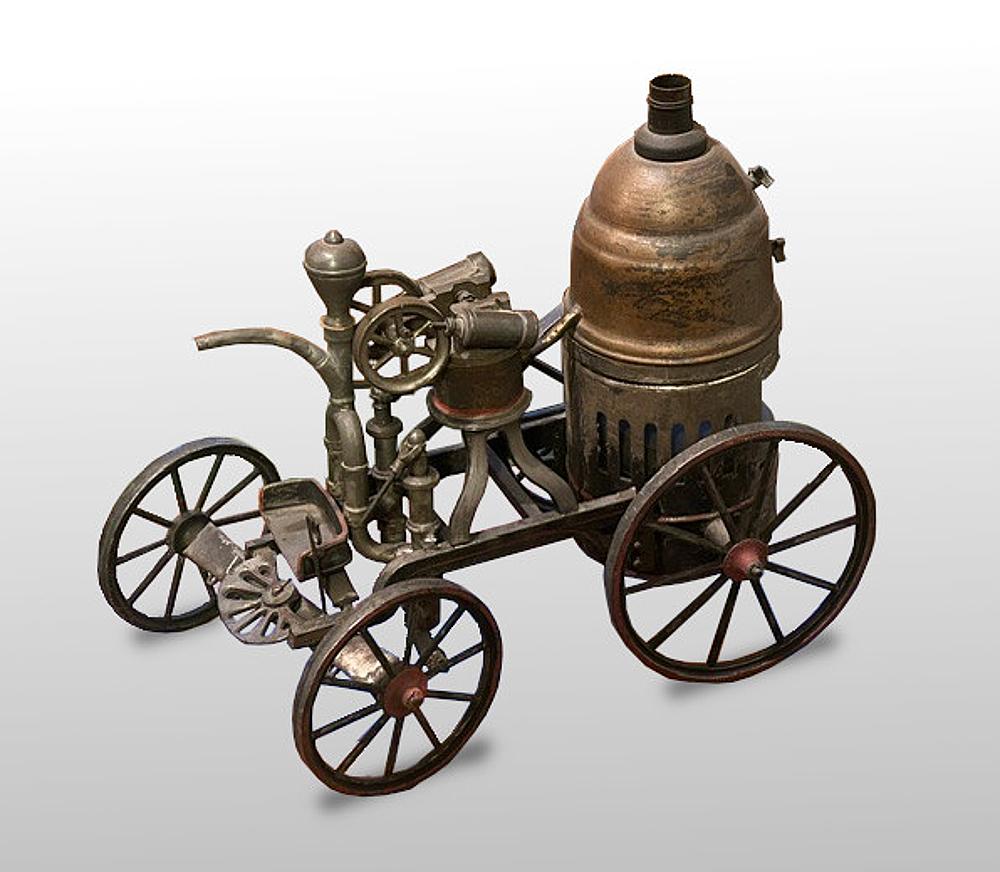
It's not known if this model is one of the eight variations, but it does show that, in addition to cylinders on the top or sides of the boiler, that they were also mounted on a separate frame.
New Accessories
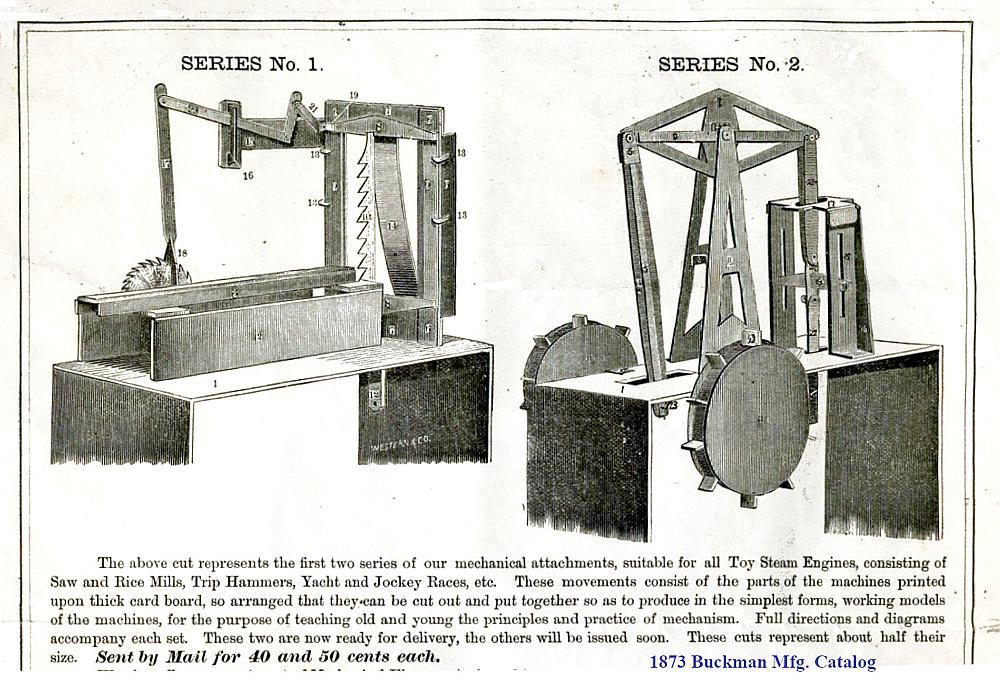
In addition to the three accessories for the new engine, the 1873 catalog also introduces two card board accessories with with several more planned. They are describe at the beginning of the catalog.
Our mechanical movements, the Saw Mill and Walking Beam Engine, are of great benefit to the youthful mechanic. Having all the parts printed on thick card board with full directions for putting them together. It requires a sharp knife, a little glue, a few pins, cigar box, a little care, and you have as perfect a machine as you can find on a large scale. You have learnt something, and derive amusement at a small expense
A cigar box on its side (not included) appears to serve as the stand. The beam engine is driving paddle wheels as might be found on a ferry at the time.
1874: Buckmans Leave Brooklyn
The Panic of 1873 began in the U.S. with bank failures in September 1873. We don't know how Buckman was capitalized, though Kraft and possibly Huffington may have been investors. While Ryder would ride out the storm, Buckman's company would not, at least not as Buckman Mfg.
By the taking of the 1875 census the Buckman family had moved to Schodack, near where they lived before coming to Brooklyn. Schodack was a five-hour train ride from Brooklyn, so it's possible that the Buckmans were still involved, but there's no evidence to support that. Alexander would continue to file patent applications, none of which had anything to do with steam toys.
Buckman Manufacturing likely existed from the the second half of 1871 to the first half of 1874. Toys that can be attributed to Buckman are: the Young America No. 1, the Improved Young America No 2., the Little Giant, two steam boats, and several fire engines. Additionally, designs for the horizontal boiler and Gem steam engine began with Buckman Mfg.
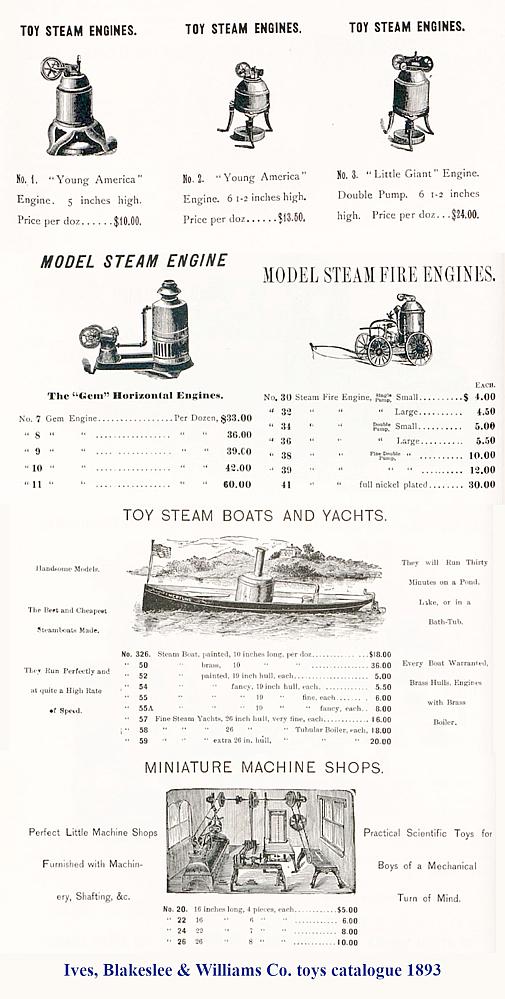
Except for the Buckman boats, most of these toys would continue to be produced for anther two decades by the Union (Toy) Mfg. Co, and can be found in the 1893 Ives, Blakeslee & Williams catalog. The Young America engines are on the bottom of page 63.
1874: Union Manufacturing Company Formed
At the 43rd Exhibition of the American Institute, an innovation fair held every year, Union Mfg. was exhibiting steam toys, which might encompass both engines and accessories. Buckman (and Ryder) attended this same exhibition in 1871.
This is the earliest evidence of a Brooklyn-based Union Manufacturing Company that can be associated with steam toys.
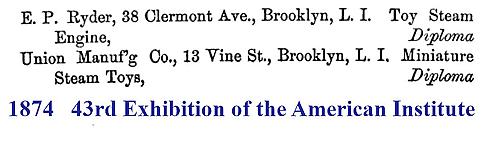
The Union Mfg. address of 13 Vine is a different address from the three used by Buckman Manufacturing Co. prior to the market crash. However, we find that directory entries from the 1874-75 Brooklyn City Directory now list 13 Vine as the business address for both Alexander Buckman and William Kraft.
--Buckman A. toy manf. 13 Vine, h 902 Gates av
--Kraft, William, toys, 13 Vine, h L. I. (Also listed under Toy Mfg & Dealers)
--Huffington John W. lumber, h Clinton House
--Greene Samuel D. machinist, h 332 Quincy
--Fitch C. W. boatbldr. Ill Fulton, h 84 Henry
While the building at 13 Vine contained multiple tenants, it's not too much of a stretch to assume that Union Mfg. was Buckman Mfg., possibly combined with other companies desiring to band together after the market crash. Huffington had gone back to lumber as his primary occupation leaving William Kraft as the person most likely to be the principal owner of Union Mfg. Co.
Samuel D. Greene is mentioned here because of his occupation as a machinist, and because he will be associated with steam toys and the 13 Vine address in later directories. Samuel and his younger relative Edward H. Greene are both linked to Union toy. Their roles are currently unknown. As a machinist, it's possible that Samuel was involved in developing steam toys that appeared after the Buckmans left Brooklyn.
1875: Parr's Miniature Machine Shops
It's reasonably clear that Union Mfg. was making steam engines, but did they also manufacture miniature machine shops?
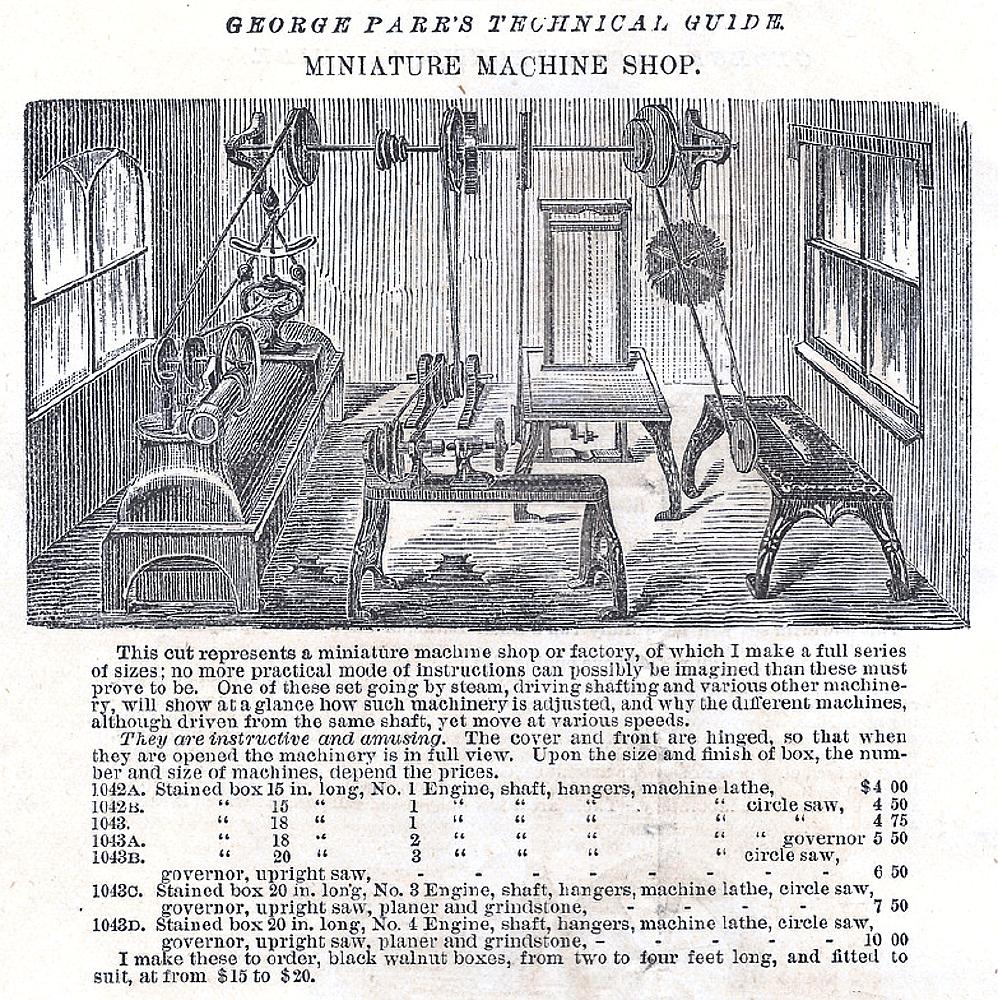
In 1875 George Parr (1830-1880) published a catalog, Parr's Technical Guide, that includes many steam engines, and also the miniature machine shops often attributed to Buckman, or Union Toy. Parr was a manufacturer, importer, and reseller with a factory in Buffalo, NY. With that as background, from the first line of text under the etching Parr makes it clear that he builds and assembles the machine shops:
This cut represents a miniature machine shop or factory of which I make a full series of sizes. [emphasis added].
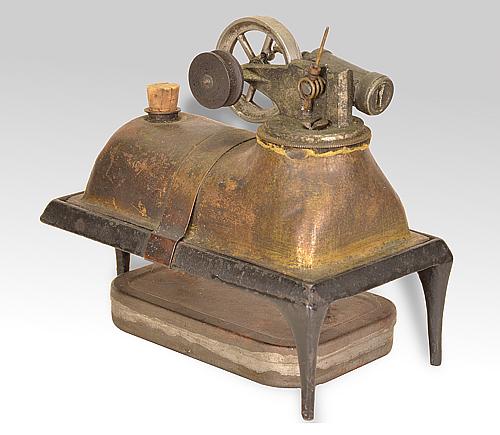
Parr's 1875 catalog is important as the steam engine shown in the machine shop is now dated to within a year or two of the formation of Union Mfg. Co. This is the horizontal first depicted in the 1973 Buckman Mfg. catalog with a boiler mounted governor. Neither catalog depicts an engine stand matching the first picture below.
Who actually manufactured the miniature tools is a mystery. It's clear that Parr sold them, as did Union Mfg. The force pump was likely derived from a Union Mfg. fire engine (pumper) and can be found with in a 1884 Wright & Ditson's catalog. The lathe and other miniature tools aren't listed in this catalog, or in Parr's (as separately available items).
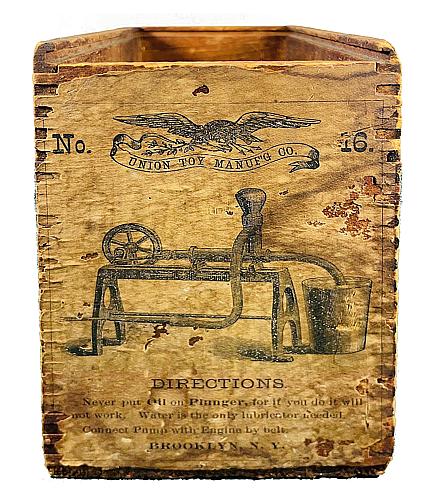
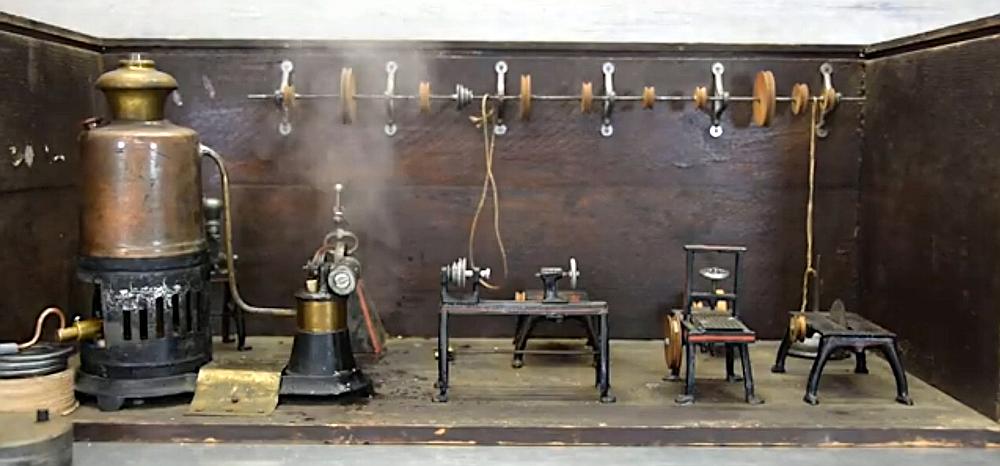
An ad for miniature machine tools can be found on page 197 in Cavalcade of Toys, but the text is unclear on the origins of this information, and the #16 pump is treated differently than the other miniature machinery. The force pump on the box, and also found hiding behind the first Gem engine below, is on a stand that looks very much like the lathe stand. Whoever made the tools, it's reasonably clear that Union Mfg. and George Parr had some kind of business relationship.
 |  | 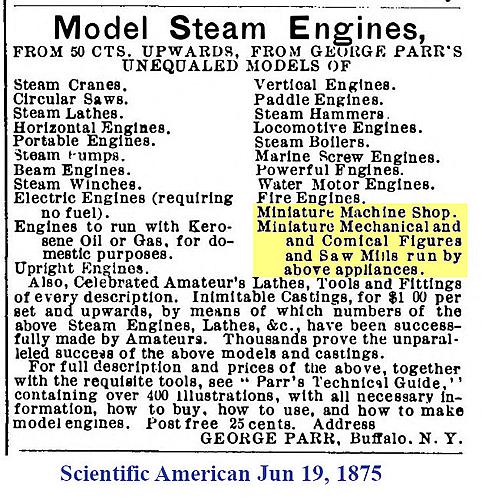 |
Parr was a well-known manufacturer of tools and castings. He took a special interest in helping to educate young men, and even boys, in all things mechanical. Perhaps a bit easier to read than the long, philosophizing introduction to his technical guide is this 1875 article in Mining and Scientific Press . The article also includes etchings for two of the model engines he sold as castings.
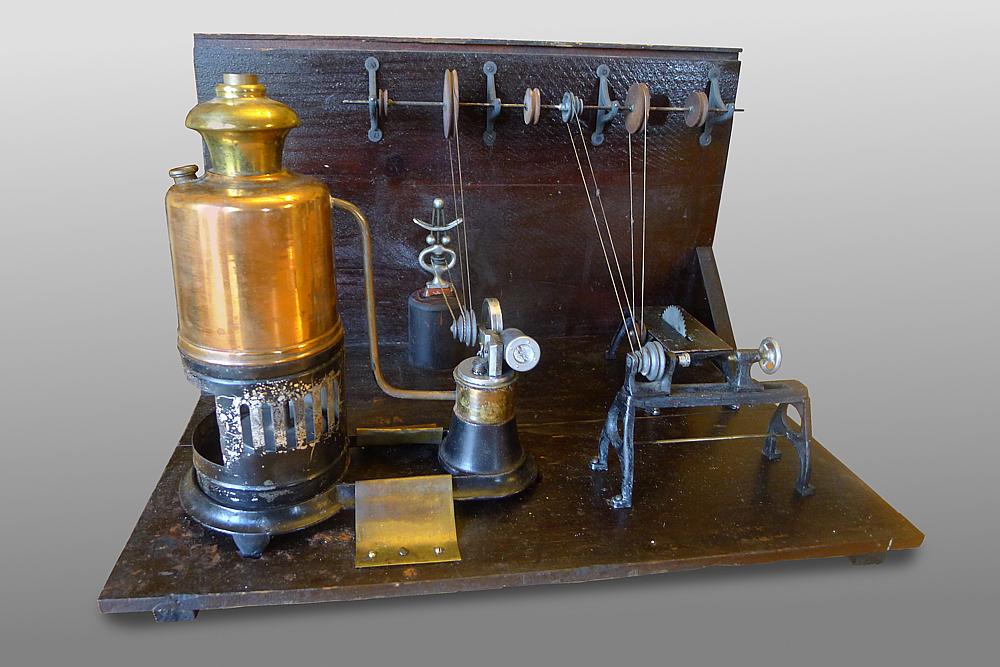
Parr also used Union's Gem steam engine for his workshops as shown below. The Union governor first shown mounted on the horizontal boiler is a separate accessory in the Gem-based workshops.
 |
 |
1875: Steamboats and Captain Fitch
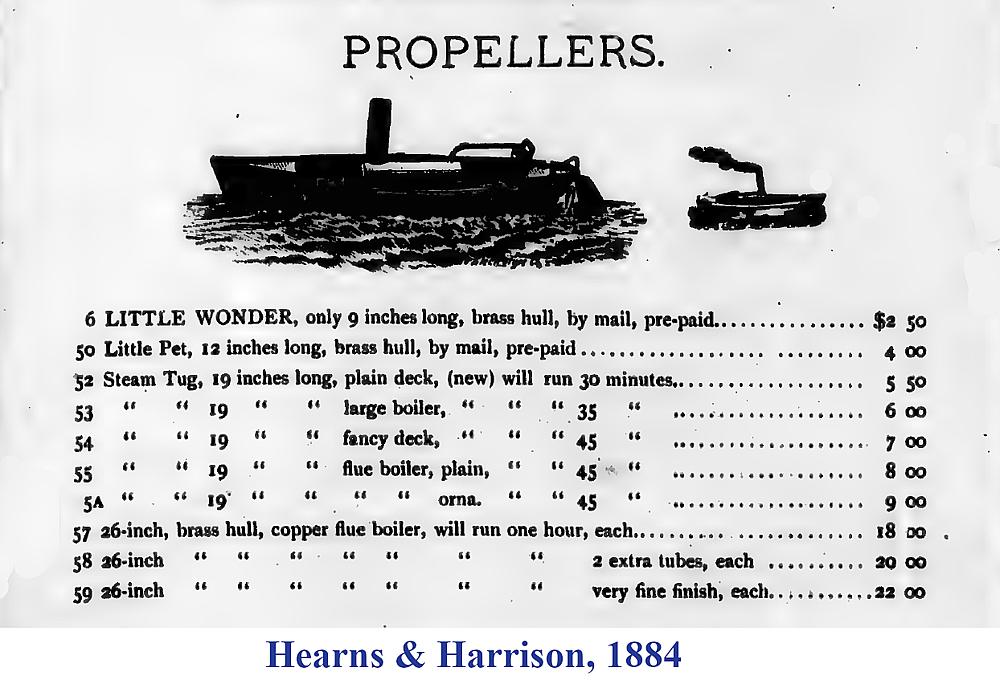
A catalog page dated 1875 and found on page 203 in Cavalcade of Toys listed "Capt. Fitch" as the hull designer for three boats: the 13" Little Pet, a 19" Steam Tug, and a 19" Revenue Propeller. By 1884 the Union Toy Mfg. line of boats was extensive, as shown in this page from a Hearns & Harrison catalog. The nine-inch Little Wonder is a smaller version of the twelve-inch Little Pet.
It's not clear if these were new products, or products of a company that existed before Union Mfg was formed. What is clear is that Union Mfg. chose not to produce the Buckman side wheeler. Propeller boats, as they were known, were modern, and would definitely go faster.
Here are auction pictures of: The Little Pet, a No. 52 and a No. 55
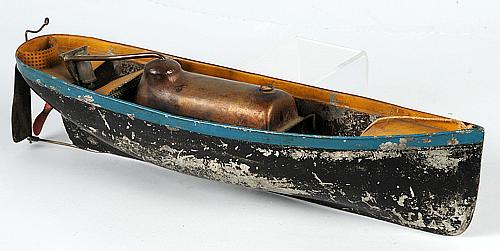
Photo courtesy of Morphy Auctions, www.morphyauctions.com
Compared to the Ryder and Buckman paddle-wheelers, the hulls on these propellers were clearly designed by someone with experience in marine architecture. The long keel would provide good directional stability, which would be important in the days before radio control, and the midship sections coupled with the low center-of-gravity horizontal boiler would provide stability without the requirement for significant ballast. The hull shape would also minimize power-robbing wake and turbulence.
Captain Fitch was famous as an inventor of steamboats. However, that Captain Fitch died in 1798 and so was unlikely to be the Fitch that designed the Union Mfg. Hulls. Instead, these were likely designed by C. W. Fitch, who's business was near 13 Vine. Fitch built model sailboats for use by the Prospect Park Model Yacht Club, Brooklyn.
What fun it must have been to race these boats against each other on the lake in Brooklyn's Prospect Park, where a finely tuned propeller and rudder, properly fired boiler, and well-oiled engine could make the difference between winning and losing. Who knows, perhaps the Buckmans met Fitch while performing sea-trials of their boats in Prospect Park. It was close to the factory.
The boiler in this 19" model is clearly an adaptation of the same Union Mfg. boiler used in Parr's workshops.
1876: The Little Wonder Steamboat
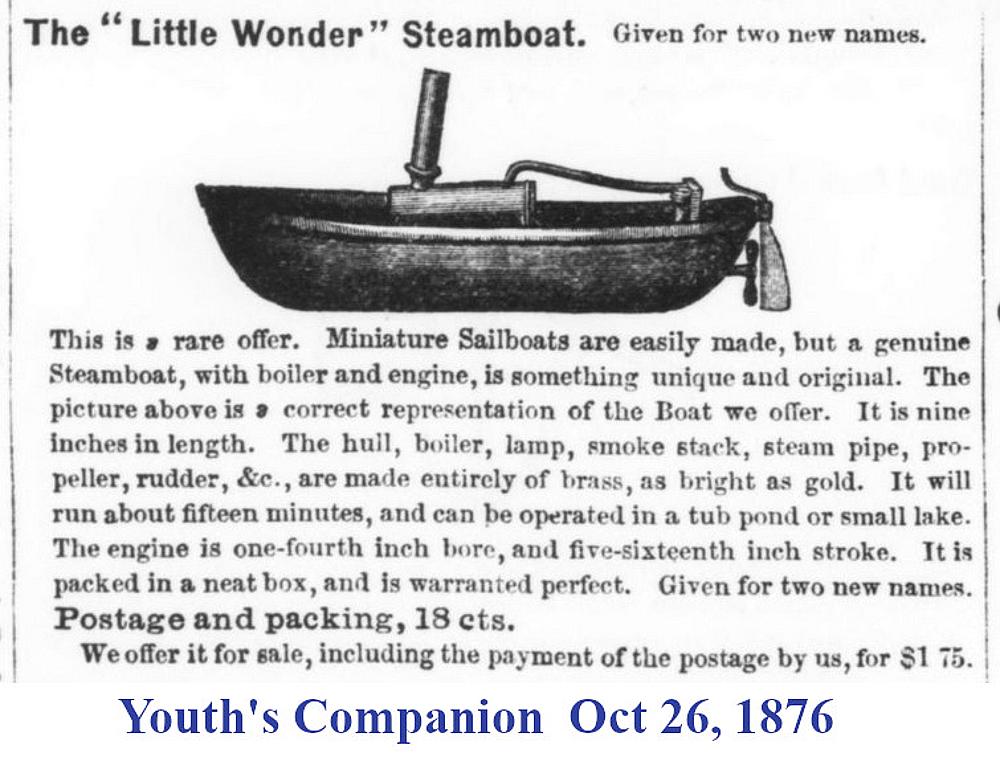
This steamboat was likely a new offering in '76 as it was not listed in the 1875 catalog discussed above. Also, as shown in this auction photo, the steamboat is the Little 76 Wonder, suggesting a tie-in to the centennial celebrations.
This product is also special as it marks the first Union Mfg. product offered as a prize in Youth's Companion. It can be found in the Oct 26, 1876 issue. It would also appear in the 1877, 1878 and 1883 issues. The boat in the 1884 issue was likely a new fancy-deck variant.
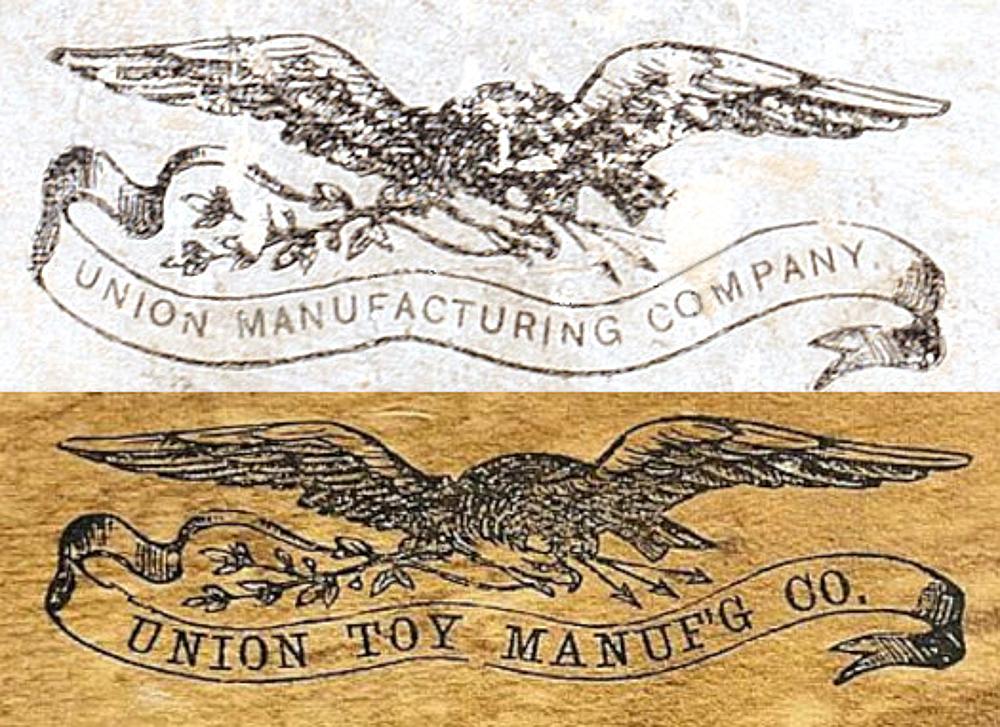
It's worth pointing out that the Little Wonder auction photo shows the company name printed on the box end as the Union Manufacturing Company, suggesting a production date prior to 1879. Two of the other auction photos, The Little Pet and the No. 52, had Union Toy Manuf'g Co. labels indicating that they were produced after 1880.
The dating of the name change will soon be explained.
1878: A Good Year
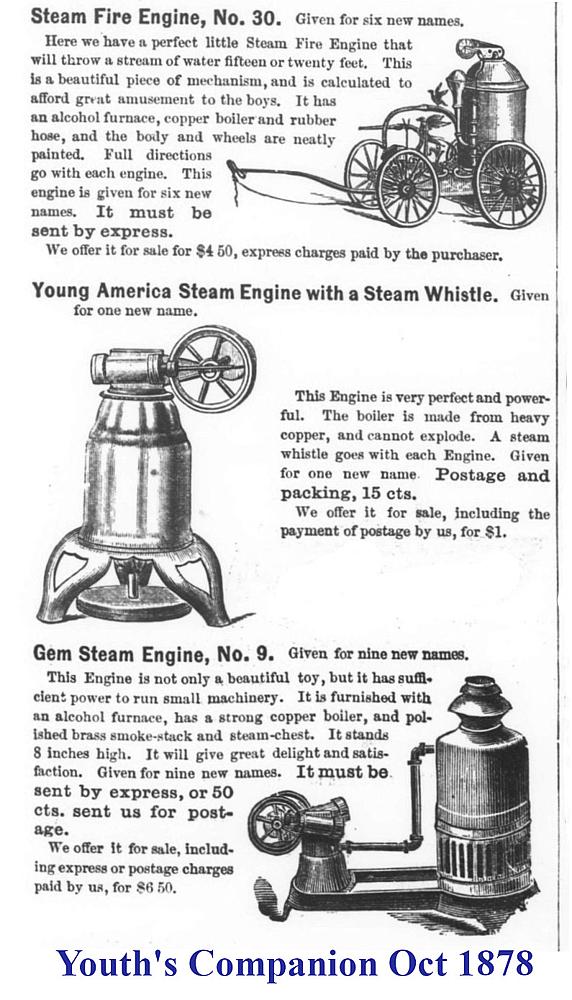
While Youth's Companion did offer the Little Wonder Steamboat as a prize beginning in 1876, Ryder had been the dominant steam-toy provider since 1871. This changed in 1878 when Youth's Companion additionally offered Union's Fire engine, along with the Young America and Gem steam engines. With this change Ryder's presence was reduced to the diminutive Half-Dollar engine.
This was a huge win for Union Mfg. Co. While we may never know why the periodical made the change, the availability of the more powerful Gem Steam Engine may have been a factor. It's not know when this engine was introduced, but this is the earliest reference as a stand-along engine so far discovered. The Gem engine appears to be a variation of the same engine found in the 1873 #17 pumper, so an earlier introduction date is likely.
Unfortunately, through no fault of their own, the Union Manufacturing Company's good fortune would soon end.
1879: Fire Destroys Union Mfg. Factory
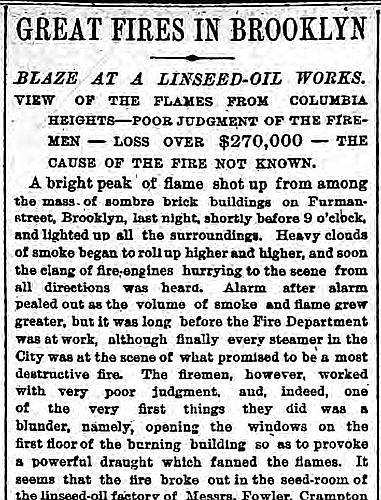
Shortly before 9pm on May 23rd, 1879 disaster would strike Union Manufacturing Company, and many other tenants of buildings located in the vicinity of a linseed oil works that caught fire.
Fueled by 250,000 gallons of linseed oil, the fire was massive; initial estimates of the damage were over $270,000 dollars. Union Manufacturing occupied the upper two floors of a four-story building making it unlikely they were able to recover much, if any of their tooling.
The New York Times wrote: "Their buildings on Columbia Heights had several tenants. These were the Union Toy Company, which occupied the two upper floors. Their loss was stated at $15,000; no insurance..."
After the fire, Union Mfg. would be unable to supply engines to Youth's Companion. As a result Ryder's engines would reappear in the periodical in 1880.
Fortunately, this is not the end of Union Mfg., but it is the beginning of the end for William Kraft's involvement. By 1883 the company would be renamed Union Toy Manufacturing Co. with Benjamin F. England as the new proprietor.
Note: The NYT article refers to the Union Toy Company which may indicate an earlier name change. However, in the 1878-79 Directory Union Mfg. is listed for the first time, and Kraft appears to be the owner. The address of 40 Fulton (now called Old Fulton) is very close to 13 Vine St.
-- Kraft Wm. toys, 40 Fulton, 64 Clinton av
-- Union Manf. Co. 40 Fulton
In the post-fire 1880 directory we find:
-- Union Manf. Co. (William Kraft) toys, 56 Columbia hgts
-- Union Manf. Co. 56 Columbia hgts
In the 1883 directory Kraft is no longer associated with toys and Union Manf. Co. is now Union Toy Manufacturing Co.:
-- Kraft William, h 64 Clinton av
-- Union Toy Manufacturing Co. (Benjamin F. England), steam toys, 105 Court home 43 Downing
-- Union Toy Manufacturing Co. 105 Court
Benjamin F. England
We know very little about Benjamin Franklin England, but by all accounts he managed to rebuild much of the company in only a few years. It's not clear how the company was capitalized after the fire.
Benjamin was born in Brooklyn, New York in 1840. A Civil War veteran, he was later involved in dry goods until becoming the proprietor of the Union Toy Manufacturing Company. This likely occurred in 1880-81 when he would have been about 40 years old. He remained the proprietor until the Panic of 1893. By 1895 he had transitioned to working for the city as a computer of accounts in the Bureau of Street Openings; a city clerk.
On June 10, 1922 Benjamin, 82, died in the same home he lived in when he took over Union Toy. His New York Times obituary was published on June 14, 1922:
BENJAMIN FRANKLIN ENGLAND, a Civil War veteran and formerly connected with the Department of Street Opening of the old City of Brooklyn, died at his home, 43 Downing Street, Brooklyn, on Friday. Mr. England was born in Brooklyn and before entering the city's employ was a manufacturer of toys in this city. He was a member of U. S. Grant Post, G. A. R., and, of the Veterans' Association of the Thirteenth Regiment.
1881: A New Engine?
In the Youth's Companion 1881 supplemental a Young-America-style engine appears perched above two Ryder engines. This new steam engine is possibly Union Toy's attempt to get something to market quickly after the fire. While Youth's Companion was likely sympathetic to Union Toy's situation, they too had a business to run and would want evidence that the company could quickly restore production after the fire.
With the removable stand, and most likely a copper boiler, this new engine certainly has Young-America DNA. Even the beaded flywheel is reminiscent of the very first engines.
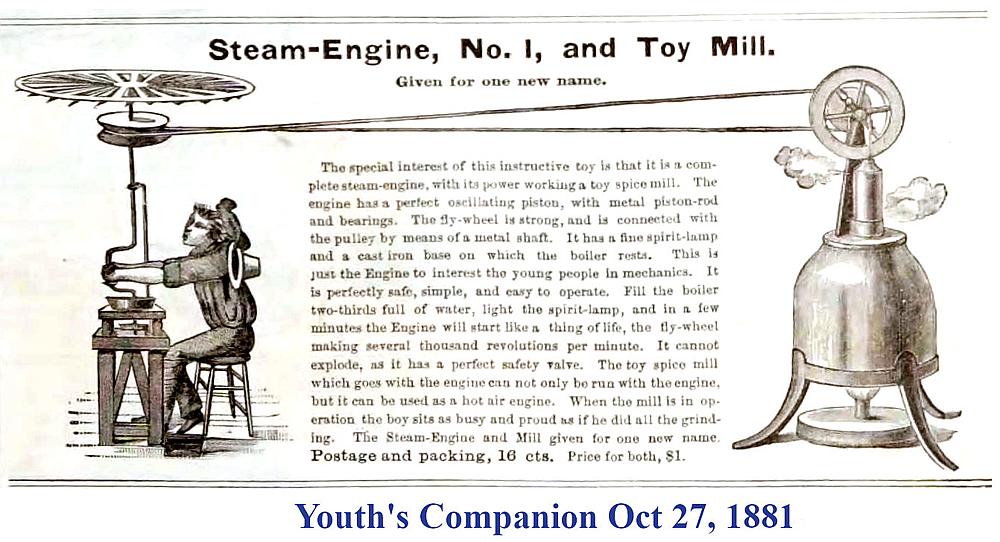
While there are many reasons to suspect that this engine was built by Union Toy, there's no other supporting evidence. For example, the engine does not appear alongside other Union Toy engines in later publications. For all we know it could have been made by Alexander Buckman as a one-off to help his friends after the fire. Alternatively, Youth's Companion may have been testing a completely new supplier.
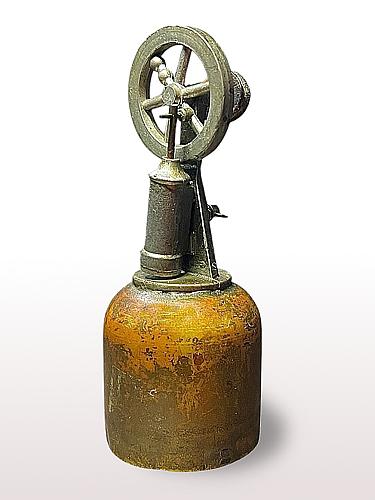
The beaded-flywheel engine shown here a is likely the engine in the etching above. The only significant difference is that the copper boiler has a slightly simplified shape.
In Buckman/Union engines the copper boiler was pressed to shape before a copper bottom was attached. For this engine, tooling marks suggest that pressing was used to form a cup, after which the top was shaped using a metal spinning process. The white-metal engine frame is soldered to the boiler and is not removable.
Watch this magnificent engine run like new when it was still only 141 years old. Note: the engine stand in the video is not original.
1883-84: A Brief Return to Youth's Companion
Two Union Toy products would again be offered as prizes for new subscriptions in the Oct 25, 1883 issue: the horizontal engine first seen in Parr's workshop, and the Little Wonder steamboat. Ryder's walking-beam engine was also offered as a prize.
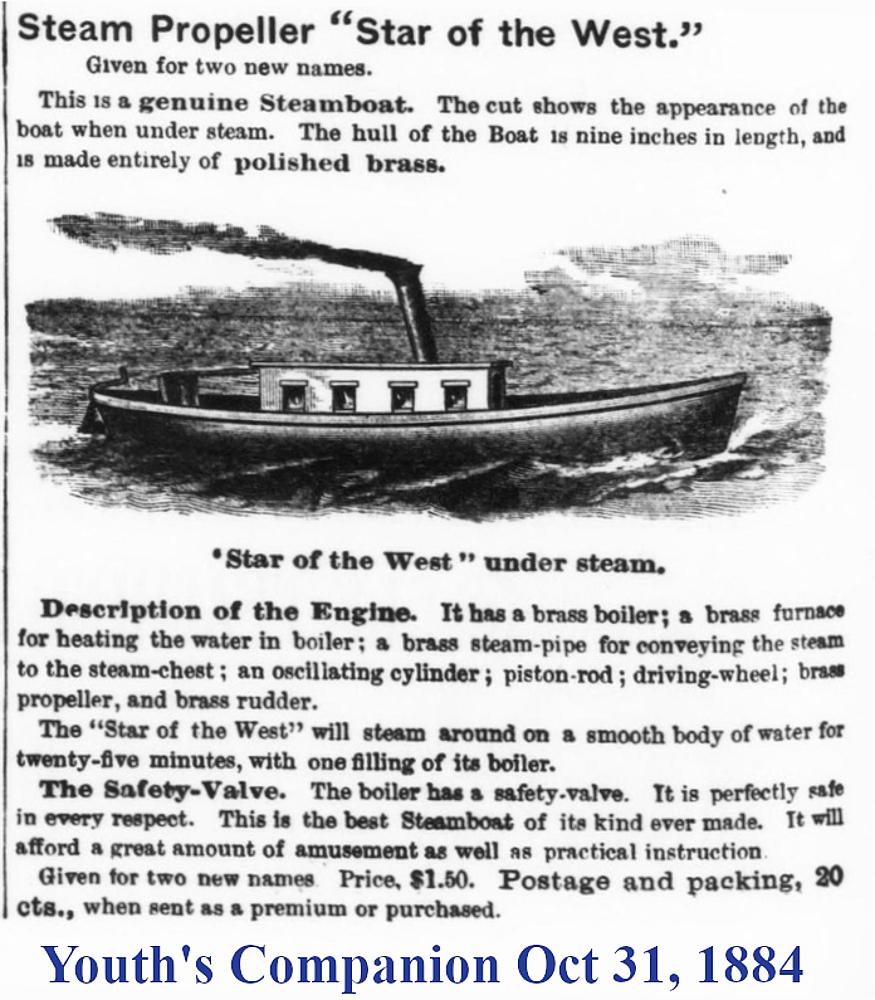
While the Little Wonder Steamboat isn't listed for 1884, this Star of the West steam propeller has a very familiar look to it. The length is specified as 9", so it's possible the Little Wonder has been given the fancy deck treatment.
This was the end of the line for both Ryder and Union Toy as suppliers of steam engines to Youth's Companion. In the Oct 30, 1884 issue the torch (spirit lamp?) is passed to Weeden with the debut of their #1 upright engine. 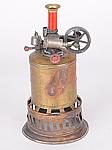
Weeden history can be found at www.TheLampworks.com and WeedenSteam.com
1884-1893
While Union Toy was no longer a supplier for the Youth's Companion periodical, the company would continue to manufacture toys. From the 1893 Ives, Blakeslee & Williams Co. toys catalogue it's clear that Union Toy has rebuilt, and possibly even slightly expanded their product line with new variations on their original products. For example, in 1893 there were five variations of the Gem horizontal engine. Other than the 1881 engine in Youth's Companion, there's no evidence to suggest that Union Toy ever introduced a totally new product after the 1879 fire.
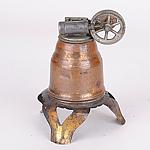
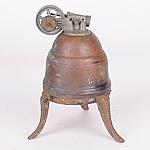
After more than two decades, the original Buckman Young America and Little Giant engines were still in production. With their long production history and their sturdy copper boilers, it's understandable that Buckman is the generic name everyone automatically associates with antique steam toys. It doesn't hurt that the Buckman name is more memorable than Ryder, or Union.
Click on these Young America engines for a closer look.
 |  |
The End of Union Toy Manufacturing Co.
In May 1893, twenty years after the Panic of 1873 and the formation of Union Mfg. Co. there would be another market crash leading a severe recession and leaving Ives, Blakeslee & Williams Co. unable to pay their suppliers. They would be forced into receivership by 1897. Unfortunately, the Panic of 1893 also appears signal the end of Union Toy. By 1895, proprietor Benjamin England was employed as a city clerk.
Loose Ends
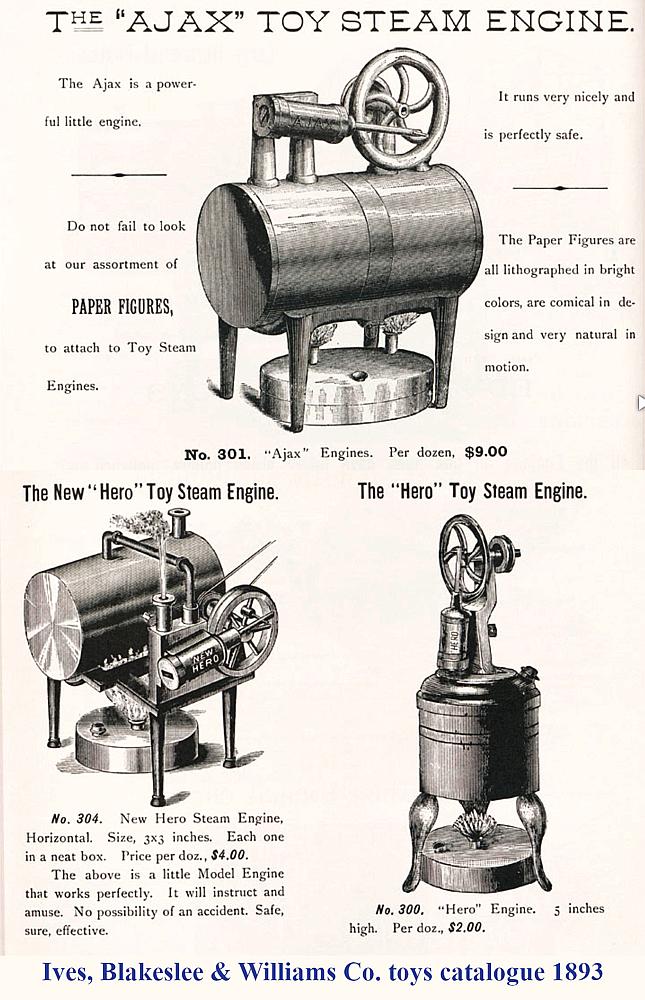
The 1893 Ives catalog includes three engines, the origins of which are unknown: the Ajax, Hero, and New Hero.
Based on the donut flywheel, curved spokes and oval burner, the Ajax engine was most likely made by Ryder.
This John Wilkinson Company ad in Youth's Companion tells us the Hero engine dates back to at least 1886.
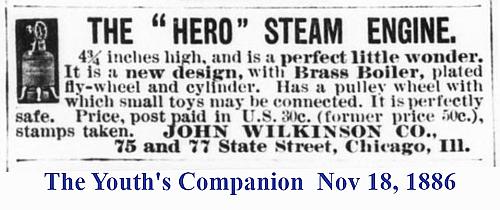
Wilkinson sold tools, steam engine casting kits, and many other things but is unlikely to be the engine manufacturer.
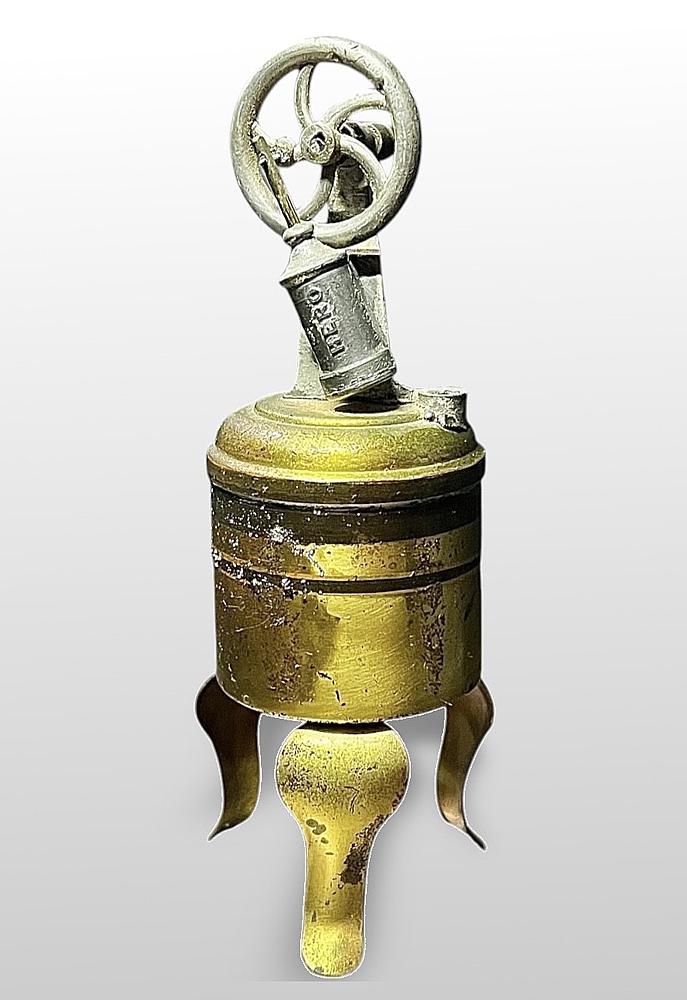
With a donut flywheel, curved spokes, and a brass boiler this surviving example of the Hero engine also has more in common with previous Ryder designs than Buckman/Union. With names embossed on the cylinders for all three engines, it's likely that they're all from the same manufacturer.
Disclaimer and a Request
In this series of articles, the Buckman Mfg. attribution that many engines receive in auctions, toy books, forums, and articles was questioned. This was not the original goal, but rather the result of much research. All references were provided so that you can understand how the conclusions were reached. It's possible that some of these conclusions are wrong, in which case these articles will be updated if new information becomes available.
In the late 19th century is was relatively uncommon for manufactures to brand their toy and novelty products. And while many manufacturers designed their own products, it was also common for independent designers to license their design, usually after being granted a design patent. Often the retailer would put their own name on the product and shamelessly claim to be the manufacturer, or a least a manufacturer, allowing the consumer to draw their own conclusions. Wholesalers, retailers and magazines might also source their toy engines from more than one manufacturer, which might cause someone to erroneously believe that all of the engines on a catalog page came from one manufacturer.
This article contains many links to outside sources. The links I worry about most are the auction pictures. Please let me know if you find links that no longer function. Or, better yet, send me pictures of your engines that I can use in place of the links.
Finally, a special thanks to Nick, Brent and others for supplying pictures and other information used in this article. Thanks also to Google Web Search, Google Books, and Archive.org for providing access to digitized publications, and for making those publications searchable, and to Morphy Auctions for allowing me to use one of their auction pictures.
Please send any comments or suggestions to 